

When it comes to protecting your sensitive equipment and personnel from electrostatic discharge (ESD), the right continuous ESD monitor is essential. You should consider models like the Desco 19336 Multi-Mount Monitor and the Botron Black Single Operator Monitor for their versatility and user-friendly features. Look for real-time monitoring, alarm alerts, and compliance with industry standards. Choosing the right monitor enhances safety and operational efficiency. Explore more options and insights to find the best fit for your needs.
ESD TR1.0-01-01: Survey of Constant (Continuous) Monitors for Wrist Straps

When it comes to ensuring safety in ESD-sensitive environments, the “Best Continuous ESD Monitors” are ideal for electronics manufacturers and technicians. The ESD TR1.0-01-01 survey evaluates constant monitors for wrist straps, highlighting their effectiveness and reliability. It discusses various technologies that maintain electrostatic discharge control and emphasizes the significance of adhering to industry standards. By understanding these monitoring systems, you can protect both personnel and equipment. The report summarizes key findings and offers best practice recommendations, helping you choose the right monitoring solutions for peak performance in your ESD control programs.
Best For: Electronics manufacturers and technicians working in ESD-sensitive environments seeking reliable monitoring solutions for wrist straps.
Pros:
- Effective ESD control: Ensures personnel safety and equipment protection in sensitive environments.
- Variety of technologies: Offers different monitoring systems to suit various operational needs.
- Industry standards compliance: Facilitates adherence to best practices and protocols for optimal performance.
Cons:
- Initial cost: May involve higher upfront investment for quality monitoring systems.
- Maintenance requirements: Continuous monitors may require regular upkeep and calibration.
- Complexity of selection: Choosing the right monitor can be challenging due to the variety of available technologies.
Desco 19336 Multi-Mount Continuous Monitor w/North American Plug

The Desco 19336 Multi-Mount Continuous Monitor excels in versatile installation options, making it perfect for users needing consistent ESD monitoring. With its North American plug, you can easily set it up in various environments, ensuring your electronic components stay protected. This monitor continuously tracks performance, giving you peace of mind that your workspace is ESD-safe. Whether you’re in a manufacturing facility or a lab, this device adapts to your specific needs. Desco’s commitment to quality in electronic monitoring shines through in this model, providing reliable performance that you can trust for all your ESD monitoring requirements.
Best For: Users requiring consistent ESD monitoring in various settings such as manufacturing facilities or labs.
Pros:
- Versatile installation options with multi-mount capability for different environments.
- Continuous performance tracking ensures ongoing ESD safety.
- User-friendly setup with a North American plug for easy integration.
Cons:
- Limited to North American plug, which may require adapters for international use.
- Potentially higher cost compared to basic monitoring solutions.
- Installation may require additional hardware for optimal placement in some settings.
Botron Black Single Operator and Mat Continuous Monitor
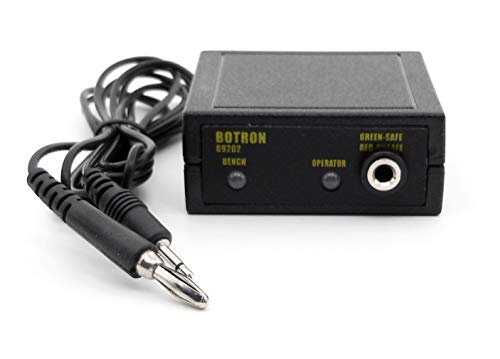
If you’re looking for a reliable continuous ESD monitor, the Botron Black Single Operator and Mat Continuous Monitor (Model B9202) stands out. Designed for safety and precision, it features an LED alarm that clearly indicates pass or fail status, helping you maintain ideal conditions. The monitor connects easily via a banana jack, guaranteeing quick setup. Its sleek black design fits seamlessly into any workspace. Plus, it includes a ground wire for extra safety and grounding purposes. With the Botron monitor, you can confidently protect your equipment and guarantee a controlled environment, making it an essential tool in any ESD-sensitive area.
Best For: The Botron Black Single Operator and Mat Continuous Monitor is best for professionals in ESD-sensitive environments looking to ensure equipment safety and compliance.
Pros:
- LED alarm provides clear pass/fail indications for easy monitoring.
- Easy connectivity with banana jack input allows for quick and simple setup.
- Sleek black design fits well in any workspace without being an eyesore.
Cons:
- Limited to single operator monitoring, which may not suffice for larger teams.
- Requires a separate grounding point for optimal functionality.
- May not include advanced features found in more expensive monitors.
Static Care Constant Monitor with Audio & Visual Alarms

For professionals managing ESD-sensitive environments, the Static Care Constant Monitor stands out with its audio and visual alarms. This single wire continuous monitor protects against ESD damage by ensuring your wrist strap’s effectiveness. With no calibration needed, you simply plug it in, and monitoring starts immediately. A green light confirms a safe connection, while a red light and audible alarm alert you to any issues. Compatible with all standard single wire ESD wrist straps, this device utilizes specialized impedance sensing technology to check your entire ground loop. It meets ANSI ESD-S20.20 standards, ensuring compliance without the hassle of frequent recalibrations.
Best For: Professionals in ESD-sensitive environments seeking reliable and hassle-free wrist strap monitoring solutions.
Pros:
- No Calibration Required: Easy setup with factory calibration, eliminating the need for adjustments or annual recalibration.
- Real-Time Monitoring: Continuous testing of ESD wrist straps provides immediate alerts for unsafe connections.
- Broad Compatibility: Works with all standard single wire ESD wrist straps, ensuring versatility in various settings.
Cons:
- Single Operator Limitation: Designed for use by one operator at a time, which may limit efficiency in busy environments.
- Dependence on Wrist Strap: Effectiveness relies on the proper use of compatible wrist straps; ineffective if the strap is faulty.
- No Advanced Features: Lacks additional features or customization options that some users may expect in more advanced monitoring systems.
FEITA 209-II Anti-Static Wrist Strap Tester

Looking for a reliable ESD wrist strap monitor? The FEITA 209-II Anti-Static Wrist Strap Tester is an excellent choice. With plug-and-play functionality, it offers real-time monitoring of your wrist strap’s wear and grounding status. You’ll appreciate the built-in alarm system that alerts you if the discharge path fails for just 0.1 seconds. Plus, you can easily adjust testing parameters between 1.068 – 2.0 MΩ to suit your needs. Its compatibility with most wristbands and strong anti-interference capabilities make it perfect for various environments, enhancing your safety protocols with prompt alerts to any abnormalities.
Best For: Professionals in environments where electrostatic discharge monitoring is crucial, such as electronics manufacturing and clean rooms.
Pros:
- Real-Time Monitoring: Provides constant supervision of wrist strap effectiveness and grounding status.
- Customizable Sensitivity: Easily adjustable test parameters to meet specific user requirements.
- Wide Compatibility: Works with most wristbands available on the market, ensuring versatility.
Cons:
- Limited to Wrist Straps: Only monitors wrist straps, not other ESD protective equipment.
- Initial Calibration Required: Users may need to calibrate settings for optimal performance.
- Potential False Alarms: Sensitivity adjustments may lead to occasional false alerts if not properly set.
Transforming Technologies CM410 ESD Workstation Monitor

The Transforming Technologies CM410 ESD Workstation Monitor stands out for its ability to continuously monitor one wrist strap and one ESD work surface. You’ll appreciate how easy it is to use—just plug in the wrist strap and you’re ready to go. This monitor is compatible with standard single-wire wrist straps, ensuring versatility in your setup. Plus, it features audible and visual alarms, providing immediate feedback if there’s an issue. With factory calibration, you won’t need to make adjustments or worry about annual recalibration, making it a hassle-free choice for your ESD safety needs. Stay protected and precise with the CM410.
Best For: The Transforming Technologies CM410 ESD Workstation Monitor is best for professionals in electronics manufacturing and assembly environments who require effective ESD monitoring.
Pros:
- Easy to use: Simply plug in the wrist strap for immediate operation.
- Versatile compatibility: Works with standard single-wire wrist straps.
- No calibration needed: Factory calibrated, eliminating the need for adjustments or annual recalibration.
Cons:
- Limited monitoring capacity: Monitors only one wrist strap and one work surface at a time.
- Dependence on wrist strap: Requires a compatible wrist strap for functionality.
- No advanced features: Lacks additional monitoring options or customization settings.
FEITA ESD Wrist Strap Alarm Tester Instrument

Operators in electrostatic-sensitive environments will find the FEITA ESD Wrist Strap Alarm Tester Instrument invaluable. This dual constant anti-static wristband tester continuously monitors your electrostatic wrist straps and ground wire access, ensuring your safety. With real-time alerts for any abnormal conditions, you can trust it to keep you informed. The plug-and-play functionality and adjustable test parameters between 1.068 – 2.0 MΩ make it user-friendly. Designed with high precision components, it offers strong anti-interference capabilities. Whether in a lab or production area, this reliable tool enhances your safety, allowing you to focus on your work without worry.
Best For: Operators in electrostatic-sensitive environments who require continuous monitoring of their anti-static wrist straps for enhanced safety.
Pros:
- Real-time monitoring provides immediate alerts for any abnormal conditions.
- Plug and play functionality makes it easy to set up and use without extensive training.
- Adjustable test parameters allow customization for various wrist strap types and conditions.
Cons:
- Initial cost may be high for smaller operations or individual users.
- Limited portability as it is designed primarily for workstation environments.
- Dependence on power source may pose challenges in remote or mobile settings.
Factors to Consider When Choosing Continuous ESD Monitors
When you’re choosing a continuous ESD monitor, consider several key factors that can impact performance. You’ll want to evaluate the monitoring technology options, alarm features, and installation flexibility. Don’t forget to check calibration needs and compliance with industry standards to guarantee reliability.
Monitoring Technology Options
Choosing the right continuous ESD monitor involves considering several key technologies that guarantee effective real-time monitoring. Look for models utilizing impedance sensing and microcomputer control, as these secure accurate tracking of wrist straps and grounding status. Many monitors come factory calibrated, eliminating the hassle of regular calibration and securing consistent performance. You’ll also want to check for adjustable sensitivity settings, allowing you to tailor alerts to your specific operational needs. Compatibility with standard ESD wrist straps is essential for seamless integration into your existing ESD control programs. This combination of features will help you maintain safety and precision in your workspace, securing that you’re always aware of your grounding status without unnecessary complications.
Alarm Features and Alerts
While selecting a continuous ESD monitor, it’s crucial to take into account the alarm features and alerts that guarantee immediate feedback on wrist strap performance and grounding status. Look for monitors with both audio and visual alarms to make certain you’re promptly informed of any issues. For instance, LED indicators can show a green light for safe connections and a red light with sound alerts for unsafe conditions. Adjustable alarm sensitivity is a great feature, allowing you to customize alert thresholds based on your specific needs. Regularly monitoring these alarms greatly reduces the risk of unnoticed ESD events, protecting sensitive electronic components and enhancing personnel safety. Make sure you choose a model that fits your requirements for ideal protection.
Installation Flexibility and Compatibility
Installation flexibility and compatibility are vital factors in selecting a continuous ESD monitor, as they directly impact how effectively the device integrates into your workspace. Look for monitors that offer multi-mount capabilities, allowing you to adapt to various configurations easily. Make sure the monitor is compatible with standard wrist straps, so it works seamlessly with different ESD wristbands available on the market.
User-friendly models that operate without extensive calibration simplify setup and minimize maintenance, making them ideal for diverse environments. Additionally, consider options that integrate smoothly with your existing ESD control systems. Real-time monitoring features are essential as well, providing immediate feedback on wrist strap performance and grounding status, guaranteeing you comply with ESD safety protocols efficiently.
Calibration and Maintenance Needs
Understanding calibration and maintenance needs is key when evaluating continuous ESD monitors. Many models come factory calibrated, which means you won’t need to make regular adjustments or annual recalibrations, simplifying your maintenance efforts. Some monitors are even designed to require no calibration at all, guaranteeing they’re ready to use right after installation. However, you might want to adjust calibration parameters to customize sensitivity based on specific operational requirements. Even for factory-calibrated devices, regular maintenance checks are essential to guarantee ongoing reliability and performance. Keep in mind that certain industry standards may dictate specific calibration and maintenance protocols that you’ll need to follow for peak ESD control. Choosing a monitor with manageable calibration needs can save you time and hassle.
Compliance With Industry Standards
When selecting continuous ESD monitors, it’s vital to verify they comply with industry standards, as this considerably impacts their effectiveness in sensitive environments. Look for monitors that meet ANSI ESD-S20.20 standards to guarantee effective electrostatic discharge control. Compliance with ESD 4.1 recommendations is also important for the reliability of wrist strap monitoring systems. Confirm the monitors are factory calibrated and adhere to industry specifications, minimizing the need for frequent recalibrations and maintaining consistent performance. Choosing monitors with established safety certifications enhances operator safety and reduces ESD-related risks. Regular audits and strict adherence to compliance protocols help sustain an effective ESD control program, protecting both personnel and sensitive equipment in your workspace.
User-Friendly Operation and Design
Choosing continuous ESD monitors with user-friendly operation and design guarantees you can maintain a safe workspace without hassle. Look for plug-and-play functionality that eliminates complex setups, letting you get started right away. Clear visual and audio alarms provide immediate feedback on wrist strap status, ensuring safety is always in check. Opt for designs with multi-mount capabilities, allowing you to customize your monitoring setup to fit your specific workspace layout. Make sure the monitors are compatible with standard wrist straps, so you can easily integrate them into your existing ESD control programs. Intuitive indicators—like green lights for safe connections and red lights for alerts—simplify monitoring and help reduce the chances of operator error, enhancing your overall efficiency.


